RETNA American, b. 1979

"I want my text to feel universal. I want people from different cultures to all find some similarity in it-whether they can read it or not." - Retna
-
 RetnaEven the Heart Skips a Beat (black on black), 20242-color screenprint with black glitters added by hand, hand cut43 1/4 x 28 3/4 in
110 x 73 cmEdition of 99View More Details -
RetnaDance of the Sacred Memories, 2017Lithograph 4 colors printed with Marinoni Machines and hand cut on White BFK Rives 270 g. paper32 1/4 x 26 3/4 in
82 x 68 cmEdition of 99View More Details -
RetnaEven the Heart Skips a Beat , 20242-color screenprint with black glitters added by hand, hand cut43 1/4 x 28 3/4 in
110 x 73 cmEdition of 99View More Details


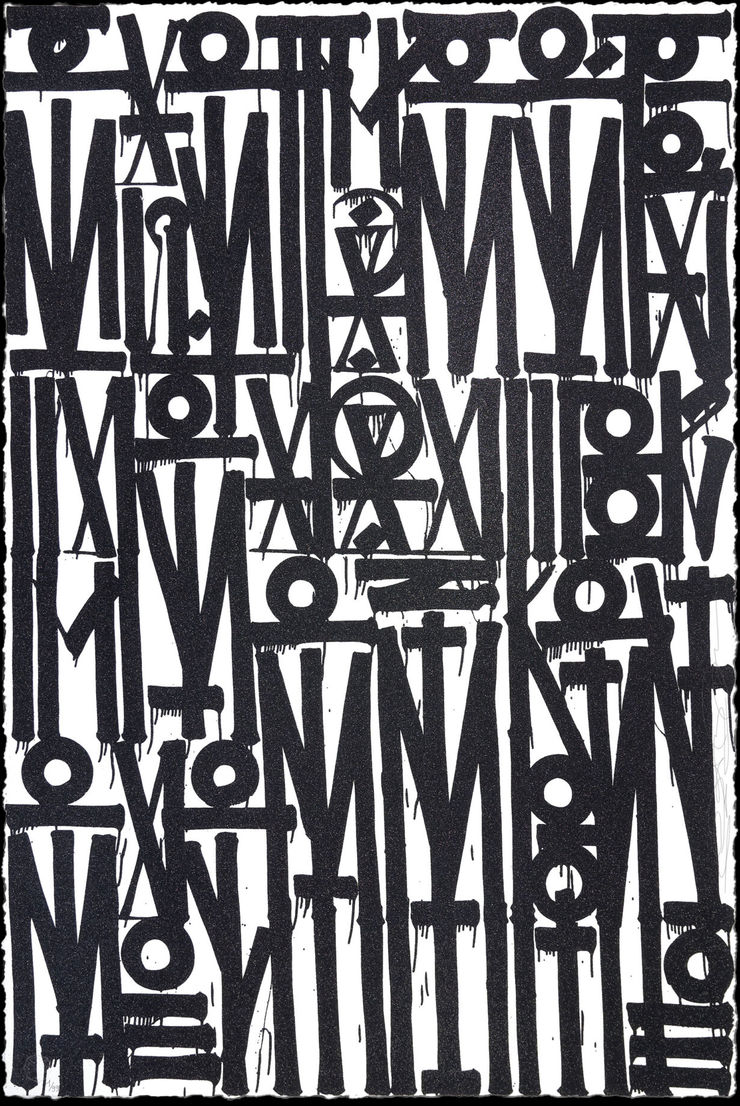

RETNA, born Marquis Lewis, began his career within the Los Angeles graffiti scene, where language, repetition, and mark-making formed the foundation of his visual identity. From early on, his work distinguished itself through an interest in structure and rhythm rather than legibility, favoring dense systems of marks that functioned as visual architecture. This approach allowed his writing to operate simultaneously as communication, pattern, and abstraction.
As his practice evolved, RETNA developed an invented script influenced by ancient alphabets, calligraphy, and global typographic traditions. Rather than translating existing languages, he constructed a personal visual system that suggests meaning without resolving into text. This ambiguity became central to the work, allowing viewers to engage intuitively rather than intellectually.
RETNA’s transition from public murals to studio-based painting marked a significant shift in scale and material focus. While maintaining the urgency and graphic power of street work, his paintings emphasize layering, erosion, and surface complexity. Crisp, repetitive glyphs are often interrupted by washes, drips, and softened passages, creating tension between precision and decay.
Culturally, RETNA occupies an important position in the broader movement of graffiti’s evolution into contemporary fine art. His work demonstrates how street-based visual language can expand into a sustained, materially rich studio practice without losing its original intensity. This transition has helped legitimize graffiti-derived abstraction within institutional and collector contexts.
For collectors, RETNA’s work offers a combination of strong authorship, cultural relevance, and visual authority. His paintings function as commanding focal points, holding presence at scale while rewarding close inspection. With a practice rooted in both contemporary culture and historical reference, RETNA’s work continues to maintain relevance within an evolving market.